-FINAL(01-00)-White&Blue-01.svg)
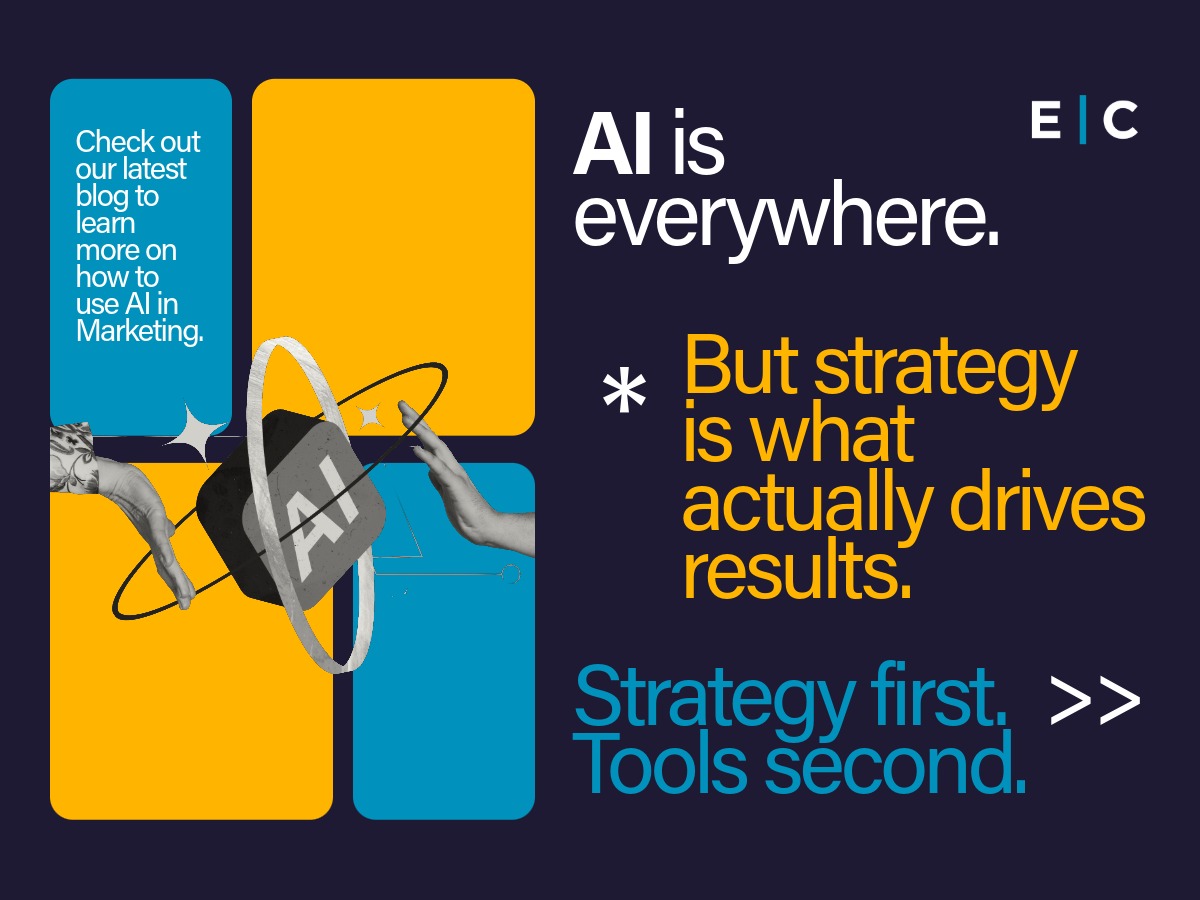
It is officially Spring 2026, and if your inbox looks anything like ours, you are probably being bombarded with the latest and greatest AI marketing tools promising to automate your entire business with a single click.
We are well past the initial hype cycle of artificial intelligence. AI is no longer a novelty; it is a permanent, foundational part of the marketing tech stack. But as the tools become more advanced, a glaring problem has emerged across the industry:
Marketers are adopting the tools without building the strategy.
And a powerful tool in the absence of a strategy doesn’t create results. It just creates noise faster and at a higher volume than ever before.
The “Shiny Object” Trap
The barrier to content creation has never been lower. In minutes, an AI platform can generate a month’s worth of blog posts, social media captions, and email sequences.
The danger here is the illusion of productivity. We are now living in the reality Gartner warned about when they forecasted that 30% of all outbound marketing messages would be synthetically generated by 2025 (Cisco 2026). It feels incredibly productive to generate 50 pieces of content in an afternoon. But if those pieces aren’t anchored to a deeper understanding of your customer’s pain points, your brand’s unique positioning, or your actual business goals, you are just adding clutter to an already overwhelming digital landscape.
A hammer doesn’t build a house on its own. It drives the nail. Your strategy is the blueprint.
When you lead with a tool, you let the software dictate the output. When you lead with a strategy, you use the software to execute your vision. Here is why prioritizing the foundational work is non-negotiable this year.
- More content doesn’t mean more conversions: The modern consumer is highly attuned to generic, AI-generated fluff. They don’t want more content; they want better, more relevant answers to their problems. According to HubSpot’s 2026 State of Marketing Report, AI is a core part of marketing workflows. 80% of marketers use AI for content creation, and 75% use it for media production (Hubspot 2026).
- AI amplifies your baseline: AI is a multiplier. If your foundational messaging is confusing or generic, AI will just scale that confusion. If your strategy is sharp, AI will scale your brilliance.
- Human insight is the differentiator: AI is trained on what already exists. Real innovation, empathy, and the ability to connect dots in unexpected ways still require a human strategist at the helm.
The Strategy-First Framework
So, how do you successfully integrate AI without losing the plot? You stop asking, “What prompt should I use?” and start asking the fundamental marketing questions.
McKinsey & Company’s landmark analysis on The Economic Potential of Generative A (McKinsey & Company 2023) highlighted that while marketing and sales account for a massive chunk of AI’s potential value, that value is only realized when the technology is embedded into a core business strategy, not just bolted on as a piecemeal tool.
Before opening any AI interface, you must lock in:
- The Objective: What exact business problem are we trying to solve with this campaign?
- The Audience: Who exactly are we talking to, and what keeps them up at night?
- The Voice: What is our distinct brand perspective that a machine cannot replicate?
- The Value: What new, original insight are we bringing to the table?
Once you have those four pillars defined, then you bring in the AI.
Let the technology help you outline faster. Leverage it to remix your original thoughts into different formats, or use it to analyze data sets to uncover hidden performance patterns. Ultimately, AI becomes the engine that takes the brilliant strategy you already developed and executes it at a scale that simply wasn’t possible five years ago.
The Bottom Line
The brands that win won’t be the ones with the most expensive AI subscriptions or the highest volume of automated posts.
The winners will be the brands that do the hard, unglamorous work of building a rock-solid strategy, and then thoughtfully apply AI to bring that strategy to life.
Don’t let the tool drive the car. Take the wheel, and step on the gas.
Ready to Build Your Strategy?
If you are tired of chasing the latest marketing trends and are ready to build a cohesive strategy that actually drives revenue, we can help. At Envision, we partner with brands to cut through the digital noise, lock in their unique messaging, and build marketing engines that work.
Contact us today to start building your roadmap.